
The teaching profession has always looked for clear, structured ways to measure effective instruction. One of the most widely used tools is the Danielson Framework for Teaching, created by Charlotte Danielson. Whether you are an educator preparing for classroom evaluations, a school leader designing professional development, or a student teacher learning how to plan lessons, understanding this framework is essential.
What Is the Danielson Framework?
The Danielson Framework for Teaching is a research-based system for evaluating and supporting teachers. Developed by Charlotte Danielson in the 1990s, it is designed to answer a simple but important question: What does good teaching look like?
The framework organizes teaching into domains and components. Each part highlights skills and behaviors that effective teachers demonstrate. Schools often use it to guide teacher evaluations, but it also works as a professional growth tool.
You can usually find a Charlotte Danielson Framework PDF online through school districts, state education departments, or professional teaching organizations. Having the PDF helps educators access the exact rubric language and use it as a reference throughout the year.
Here is an official link to the Danielson Group’s website where you can learn more about the framework and training resources.
Why the Danielson Framework Matters
The framework matters because it provides:
- Consistency – It sets a common language for what quality teaching looks like.
- Professional Growth – Teachers can use the rubric to reflect and improve.
- Fair Evaluation – Administrators can observe and measure performance using objective criteria.
- Collaboration – Teams of teachers can use the same structure to discuss teaching strategies.
Unlike generic evaluations, the Danielson Framework for Teaching PDF breaks the process down into specific, observable actions. This helps schools avoid vague feedback and instead give clear, actionable insights.
The Four Domains of the Danielson Framework
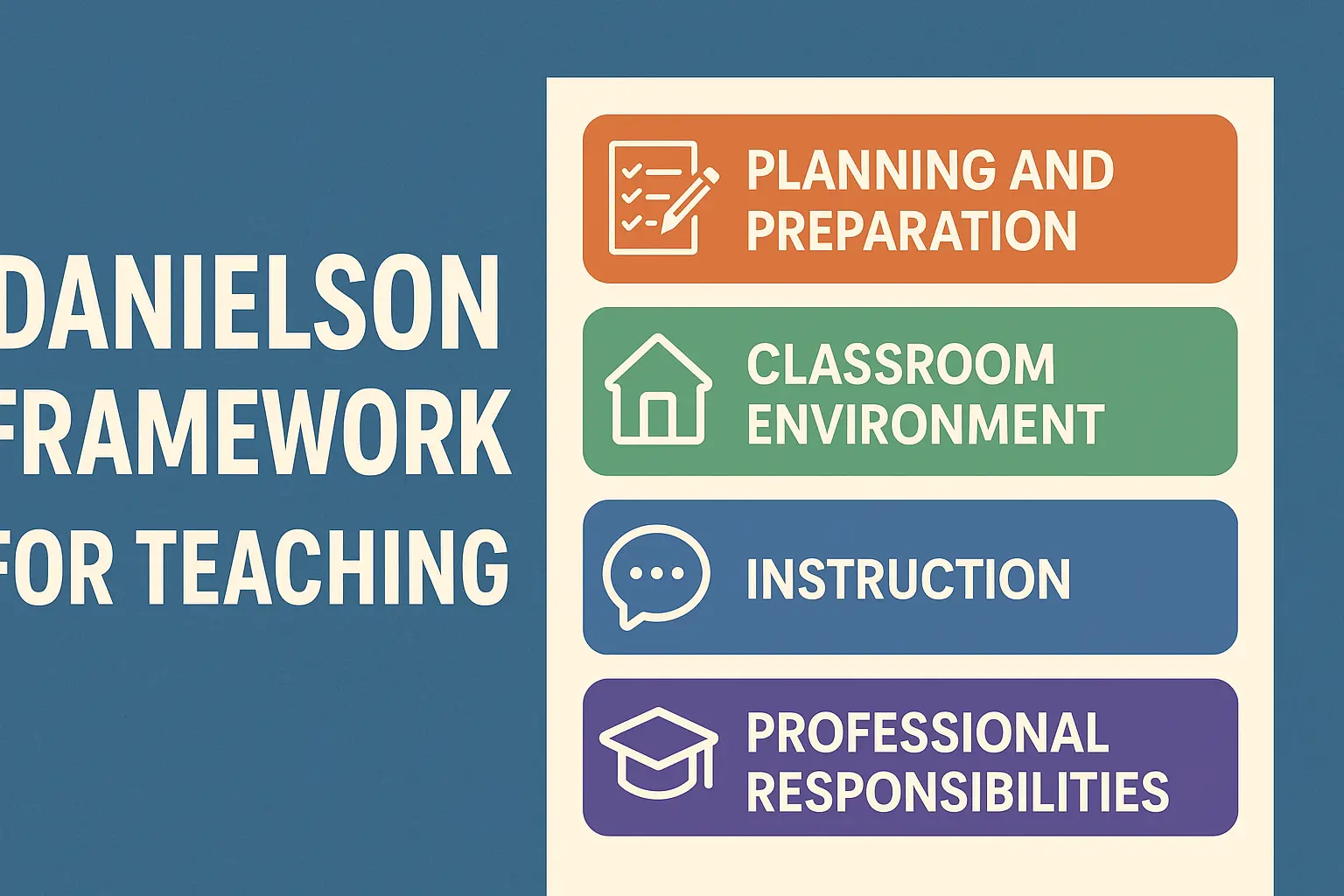
The framework is organized into four main domains. Each domain has several components, and together they create a full picture of teaching practice.
1. Planning and Preparation
This domain focuses on how well a teacher plans lessons, organizes content, and designs assessments. Components include:
- Demonstrating knowledge of content and pedagogy
- Setting instructional outcomes
- Designing coherent instruction
- Designing student assessments
2. Classroom Environment
This domain measures how a teacher creates a positive and productive environment for learning. It includes:
- Managing classroom procedures
- Establishing a culture of respect and rapport
- Managing student behavior
- Organizing physical space
3. Instruction
This is about the actual delivery of lessons. Effective instruction is at the heart of good teaching. Components include:
- Communicating with students
- Using questioning and discussion techniques
- Engaging students in learning
- Using assessment in instruction
- Demonstrating flexibility and responsiveness
4. Professional Responsibilities
The final domain goes beyond classroom teaching. It covers how teachers contribute to the larger school community. Components include:
- Reflecting on teaching
- Maintaining accurate records
- Communicating with families
- Participating in a professional community
- Growing and developing professionally
- Showing professionalism
nielson, the educator and consultant who developed the framework. She wrote several books on teaching evaluation and professional growth, such as Enhancing Professional Practice: A Framework for Teaching.
Her work emphasizes that teaching is complex, and evaluation should be both fair and supportive. The fact that her framework is still widely used decades later shows its strong foundation in research and practice.
Frequently Asked Questions
1. Is the Danielson Framework mandatory for all schools?
No. Some states require it, while others allow districts to choose their own evaluation system.
2. Can I find the Danielson Framework PDF for free?
Yes, many districts publish the framework publicly. You can also purchase official books and guides from the Danielson Group.
3. How many components are in the Danielson Framework?
There are 22 components across the four domains.
4. Does the framework apply only to K–12 teachers?
While it is most common in K–12, some colleges and training programs adapt it for higher education.
Action Steps for Teachers
If you are a teacher reading this, here’s what you can do today:
- Download a Danielson Framework for Teaching PDF from your district’s website.
- Review the four domains and reflect on where you are strongest.
- Choose one area (such as questioning techniques or classroom procedures) to improve this semester.
- Share your goals with a colleague or instructional coach.
Taking small steps like this helps make the framework practical instead of overwhelming.
Conclusion
The Danielson Framework for Teaching has become one of the most recognized systems for evaluating and supporting teachers. By organizing teaching into clear domains, it gives educators a roadmap for growth and administrators a consistent way to measure performance.
Accessing a Charlotte Danielson Framework PDF is a simple but powerful step for any teacher who wants to improve practice, prepare for evaluations, or better understand what quality instruction looks like.
For more details, you can explore: